

Nugget the Service Dog Earns ‘Juris Dogtor’ Honor at UMKC Graduation
A graduation stage at the University of Missouri-Kansas City School of Law recently carried a moment that stood out beyond traditional academic milestones.
Rebekah Arwood (J.D. ’26) walked across the stage with her service dog, Nugget, beside her. The occasion marked not only the completion of law school but also a symbolic recognition for Nugget, who received a special “Juris Dogtor” degree for his role throughout Arwood’s legal education journey.
Their story reflects a bond built through academic pressure, mental health support, structured training, and shared persistence through demanding law school years.
Beginning of An Unexpected Partnership
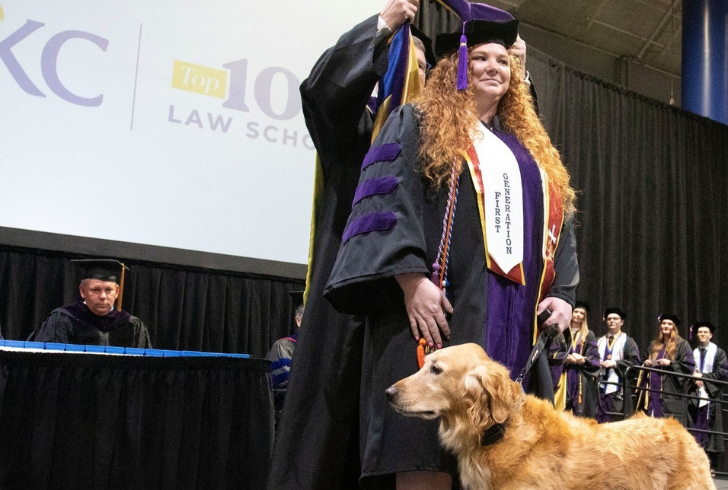
Instagram | umkc_law | UMKC Law graduate shares the stage with her service dog, Nugget, as he receives a Juris Dogtor degree.
The connection between Arwood and Nugget began in an unplanned way. A routine shopping trip for shoes shifted direction after spotting golden retriever puppies being sold roadside. That moment led to an immediate connection.
“You have to stop and say hi to puppies… and so I did. I fell in love with Nugget, and that day I took him home.”
At the time, there was no intention of training a service animal. Nugget was welcomed as a companion without a defined purpose in mind. However, after completing the first year of law school, mental health challenges became more pronounced. Anxiety and depression, present since high school, intensified under academic pressure and distance from familiar support systems.
A turning point came during periods away from home. Returning to familiar surroundings brought noticeable relief and emotional reset. That experience led to the realization that structured support from Nugget could play a meaningful role in continuing law school successfully.
Training Journey and Daily Discipline
Service dog training began in December 2023 with guidance from a local trainer. The early phase included a concentrated four-week introduction to commands and structured tasks. After that, training shifted into daily practice carried out over several months.
During the summer break between academic years, training intensified significantly. Sessions reached 6–8 hours a day for nearly a month. Consistency shaped every stage of progress, especially in reinforcing commands and behavior patterns.
“Training just takes an incredible amount of consistency and repetition,” Arwood said. “As long as you do that and you’re consistent in your commands and consistent in your behavior and in how you’re telling him to do it, training is easy if you’re consistent, just like a child.”
One of the more challenging stages involved teaching Nugget to respond to positioning commands regardless of surrounding distractions. Once that skill became stable, broader task training became more structured and predictable.
Nugget was also trained to recognize signs of anxiety or dissociation. In response, he moves between Arwood’s legs, allowing grounding through physical contact. That action helps restore focus and creates a sense of calm during stressful academic environments.
Life Inside Law School With Nugget
Before Nugget could attend classes, university procedures required documentation, including vaccination records and accommodation approval. Once cleared, Nugget became a constant presence across campus.
Faculty responses varied. Some questioned notification requirements, while others requested official approval before allowing entry into classrooms. After the first semester, communication became more streamlined through formal confirmation emails and designated contact information.
Arwood later stated, “It’s not that I didn’t care about what they thought. I knew that I had met all the requirements, and I didn’t need their approval.”
Beyond procedures, Nugget became a recognizable figure within the law school environment. Many students responded positively to his presence. Even brief interactions brought moments of relief in a high-pressure academic setting. While service dogs typically remain focused during duty, controlled interactions were sometimes allowed in informal campus settings.
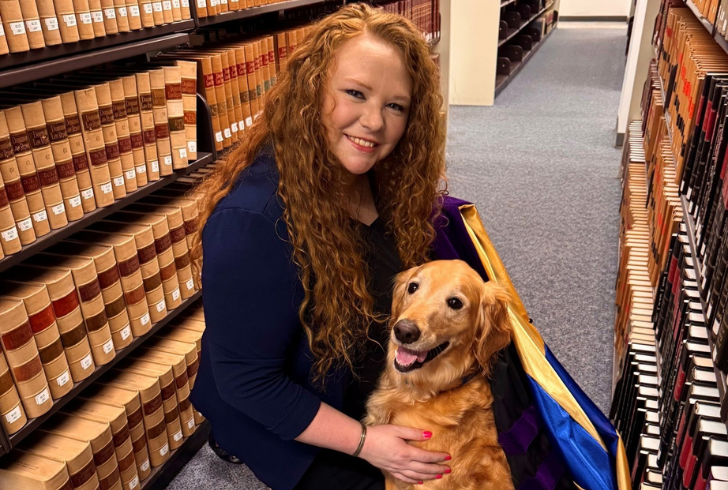
Instagram | umkc_law | Nugget became a beloved law school fixture, offering students a brief, welcome escape from academic stress.
Psychiatric service dogs often face misunderstanding due to the invisible nature of mental health conditions. Arwood emphasized the importance of awareness and clear distinction between service animals and emotional support animals.
“There is a distinction between emotional support and actual service animal,” Arwood said. “Don’t confuse the two, and don’t argue that you can have your animal anywhere and everywhere, because that hurts people who do have a service animal.”
Education and calm advocacy play a central role in addressing misinformation. Rather than conflict, clear explanation helps reinforce proper understanding of service animal roles in academic and professional spaces.
Commencement Milestone and Future Path
Following graduation, Arwood continues preparing for the bar exam scheduled for July 28–29. During this preparation period, Nugget is described as enjoying a “luxurious 10-week vacation,” while still maintaining light routines such as walks and short outings to preserve training structure.
After passing the bar, plans point toward a career in family law, with Nugget continuing to accompany Arwood in professional settings, including client meetings, offices, and court environments.
“He’ll still be on duty, just like we were in law school.”
The recognition of Nugget with a “Juris Dogtor” degree highlights more than a ceremonial gesture. It reflects structured training, emotional support, and consistent partnership through the demands of legal education.
From an unexpected meeting on a roadside to walking across a law school stage, the journey of Rebekah Arwood and Nugget underscores how service animals can become integral to navigating academic and professional pathways in high-pressure environments.
More in Law Degree
-
 When Can a Credit Card Company Sue You? Know Your Rights
Credit card debt can move from manageable to stressful when payments fall behind. Once accounts remain unpaid for a longer stretch,...
April 30, 2026 -
 Michigan Woman Accused of Locking Sister-in-Law in Basement for Two Years
A disturbing case in Saginaw, Michigan has raised serious concerns after a 58-year-old woman was allegedly held inside a basement for...
April 23, 2026 -
 Kentucky Overrides Veto to Shield Bayer From Roundup Cancer Lawsuits
A major legal and political development has unfolded in Kentucky as lawmakers moved to override Governor Andy Beshear’s veto on legislation...
April 17, 2026 -
 The Duchess of York Sarah Ferguson’s Shocking Ties to Jeffery Epstein Exposed
Sarah Ferguson, better known as ‘Fergie,’ has lived a life that rarely stays quiet. She has moved between royal privilege and...
April 10, 2026 -
 New Housing Law May Help Renters Become Homeowners More Easily
For years, renting felt like a financial dead end for many people. You pay on time every month, yet your credit...
April 4, 2026 -
 Colorado Law Bars Adult Prosecution for 11-YO Accused of Killing His Minor Brother
A quiet neighborhood in Centennial, Colorado, became the center of a heartbreaking investigation after a five-year-old boy was found dead inside...
March 29, 2026 -
 How to Handle Unpleasant Family Habits at Home Without Conflict
Family life isn’t always easy, particularly when someone’s habits start clashing with the way a household runs. From awkward bathroom routines...
March 29, 2026 -
 Britney Spears Rep Calls DUI Arrest an “Inexcusable Incident”
Britney Spears has spent decades in the public eye, but the latest headline about the pop icon carries a serious tone....
March 22, 2026 -
 Atlanta Woman Arrested in $79K Fraud After Impersonating Sheriff Captain
Authorities in Florida recently exposed a disturbing fraud operation that relied on fear, impersonation, and digital money transfers. Investigators say a...
March 22, 2026
More From Lawyers Favorite
-
 Celeb JusticeJudge Denies Release for Tate Brothers in UK Extradition Case
Andrew and Tristan Tate will remain in federal custody in Miami while they fight a British request to extradite them to...
September 25, 2026 -
 Legal AdviceDavid Yannetti Praises Lindsay Clancy’s Lawyer Amid Jury Deadlock
The Lindsay Clancy murder trial has reached another tense stage as jurors remain unable to reach a unanimous verdict. After six...
September 18, 2026 -
 Law DegreeLaw School Applications Reach Record High for 2026
Law school demand continues to rise, with applications for fall 2026 reaching another record level. New statistics from the Law School...
September 11, 2026 -
 Criminal AttorneyTupac Murder Trial Takes a Turn as Defense Calls Davis’ Claims “Bullshit”
The murder trial of Tupac Shakur has taken an unusual turn. Duane “Keffe D” Davis, the former gang leader accused of...
September 3, 2026 -
 Celeb JusticeKenny Chesney Wins Court Case in $300K Online Scam
A California appeals court has ruled in favor of country singer Kenny Chesney after a fan sued him over an online...
August 27, 2026